

Beyond the Binary: Inner Work vs Outer Change

I set out to write a short little essay to accompany this video I’ve made to kick off a series I’m doing on YouTube about the pitfalls and potentials of personal development work. (You can watch it here and if you resonate with this, please like and subscribe while you’re there!) of course, as writing tends to do, it opened up something related, but quite distinct from my initial intention. This one feels very personal. I hope it sparks a new synthesis within you as well.
I remember exactly where I was when I started arguing with my father about self-help.
Not in person, we rarely saw each other in those years. He was living in Miami at the time, then India. I was in college, deep in my own coming-of-age, deep in theory and praxis and political intensity and the heady righteousness that sometimes comes with waking up to the scale of the world’s injustices. We didn’t talk often on the phone either, but we emailed. And I would sit in the library, procrastinating on my papers, pouring my energy into long, impassioned emails to my father— arguments, really — about whether the inner world or the outer world should be the true starting place for transformation.
He had just written a book about love. He talked about love in almost everything he did. As a transpersonal psychologist, he saw it as the central thread of human healing — a force that, if cultivated within, could ripple outward to transform the world.
And I was… not convinced.
My argument was this: to speak of love as a purely internal orientation — something we must simply embody or come from — without accounting for the systems that withhold food, safety, dignity, and belonging, was not just insufficient. It felt dangerous. Romantic. Detached. Even, at times, cruel.
Because to me, love was justice. Love was policy. Love was mutual aid and clean water and land back and children no longer in cages. Love was collective. Love was structural. And love, if it were to be real, had to show up in the material conditions of people’s lives — not just in the feeling states of those who were privileged enough to spend time cultivating them.
We wrote back and forth. I sat in the library, procrastinating on papers, furiously typing rebuttals. He responded with what felt, to me, predictable.
Years later, though we were somewhat estranged, I made plans to travel indefinitely in India, beginning with staying with him and his wonderful wife in Kainchi Dham, where they lived. Plans changed when he was diagnosed with pancreatic cancer, and he was the one who came back home to me.
There was some awkwardness at times, as there often is between adult daughters of fathers who, in retrospect, may have been somewhat on the spectrum. He was brilliant but distant, never providing for me or my sister the warmth and presence that others seemed to get from him.
But in the months that followed, what began as an argument shifted to conversation. I found him more interested in my perspectives than I ever had before.
We both softened. And we began talking in new ways.
I brought him my copy of All About Love by bell hooks. He started asking questions — not defensive ones, not rhetorical ones, but real ones. About my studies in living systems. About the Holon theory of reality. We talked about what it might mean to see the individual not as a closed circuit of enlightenment, but as a nested node in the larger mesh of life.
Something changed between us then. We were no longer arguing from opposite sides of a chasm. We were circling something together. Asking different facets of the same question.
What is love, really?
And what does it ask of us?
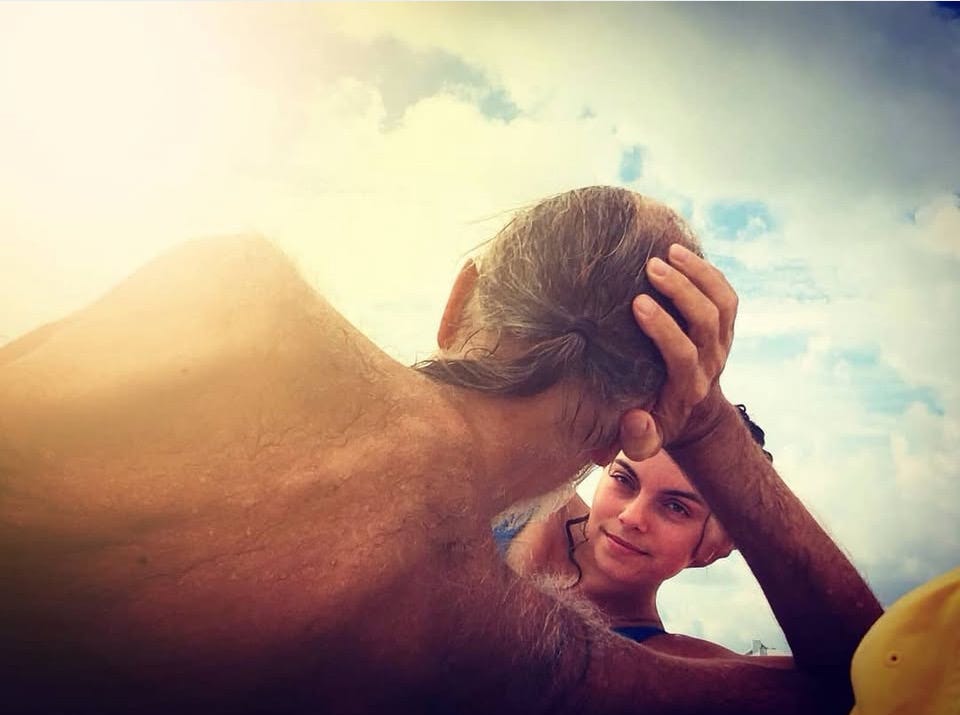
Our argument was never about whether love mattered, but about where it is directed, and how it should shape our lives. He believed the only thing that really mattered was cultivating love from within, and that that would take care of everything. I believed that love must be expressed clearly, and directed toward meaningful action and change, admittedly at the time, rather indignantly. And what I see now is that both were true and incomplete.
The synthesis of inner and outer, of personal healing and structural change is, I believe, a core challenge and opportunity of our time.
The self-help movement, in many ways, has been a response to a cultural collapse we still struggle to see, because we are still living within it: the loss of community, the alienation of industrial life, the myth of the self-made man. The wounds of modernity trained people to survive disconnection by mastering themselves. But it did not teach us how to belong.
And belonging — to land, to others, to something greater — is what love ultimately calls us into.
We live in the wreckage of Enlightenment rationalism and capitalist individualism, which taught us that the self was the primary unit of existence. But the self is not a sealed container. It is a permeable membrane. A holon, a whole within wholes.
We are shaped by culture. By class. By race and gender and land and labor. And the notion that we can “heal ourselves” without addressing the systems that injure us is not only false — it’s a kind of gaslighting. It places the burden of healing on the individual, while keeping the structures of harm intact.
And yet.
It’s also true that real healing is powerful, and it is possible. And I have come to see that inner work when done in context, in relationship, with integrity can be a site of deep systemic change. A way of restoring connection amidst the illusion of separation. It can be a practice of returning to wholeness.
So the question becomes not whether we do inner work, but how? And in service of what?
I am a student of the Law of Three. I’m not interested in arguments of thesis and antithesis forever locked in battle, but the third path that emerges through integration.
My work today lives in that third path. It’s not therapy-as-escape or activism-as-performance. It’s the living process of tending the soil of the self and of the world. Helping people grow roots in their bodies and bioregions, not to transcend reality, but to meet it with clarity, capacity, and care.
Because healing, if it is to be real, must return us to the web of interdependence. It must move us from isolation to participation. From “fixing the self” to co-creating new ways of being. With each other. With the more-than-human world. With time itself.
We are living through collapse and convergence. Through grief and emergence. Through the great unraveling — and the slow deep work of remembering of what it means to love.
I want to co-create life affirming futures, yes, and love-affirming too.
Love that is private and public.
Love that is tender and fierce.
Love that is not just a feeling, but a way of structuring reality.
This is so much of what motivates Seth and I in everything that we create. We are currently producing the EDGE, a course that shares frameworks and techniques that we believe are vitally important for the personal and collective work of sexual healing required in our times.
Today we are putting the finishing touches on the lessons being released this week, lessons that teach some of the most powerful techniques for somatic sexual healing that I personally have experienced. And we are hearing from students and clients going through the course in realtime, blown away by the healing experiences they are having.
It is incredibly gratifying to know that my work is the synthesis of a tension so close to my heart. To understand that repatterning at any point within nested systems can help to repattern the larger systems we all belong to.
I think my dad would be proud.
I love this post. You do a beautiful job of articulating my lifelong struggle to bring together the personal and the collective. I also love how you grounded it in your relationship with your dad.
One of my favorite concepts from metamodern philosophy is "dynamic oscillation." That seems like exactly what you're doing with your "third path" approach. That's the rich territory where collapse and convergence can co-exist. Thanks for the thoughtful piece. Blessings on your path 🙏🏼